
Posts Tagged »Materials«:

The Story Of Unison Color -2011 IAPS Presentation

3rd, May 2012 - 08:20 PM

During Summer 2011, The Managing Director of Unison Colour, Kate Hersey, travelled to New Mexico to the pastel convention where Kate attended as keynote speaker. In her talk she gave a brief history of Unison Colour and described how the beautiful pastels are made today. The presentation includes many photographs of the process and the staff. It shows how the color palette was inspired by the environment of Northumberland and why it differs so much from what big companies offer. A treat for all pastel artists.

In case the video doesn’t work, please use the following link: http://vimeo.com/26973681

3 Comments

Caran d’Ache Pastel Pencils and Pastel Cubes

24th, March 2012 - 12:31 PM

20111217-elbaufwaerts-008

© Astrid Volquardsen

Pastel artists usually use different kind of brands because »the« pastel stick simply does not exist. Depending on the softness of the pastel stick and the type of paper or support being used there are a different ways of creating a wide range of markings. There is not simply one way of achieving this. Furthermore, the feel of the support surface is very important for the pastel artist because a combination of stick and paper is perceived differently depending on the individual artist.

At this point I would like to point out why I like the pastel pencils made by Caran d’Ache and why I think they are an excellent addition to any pastel artist’s assortment of materials.

I paint in a rather unconventional way and so the method I use is not exactly in line with traditional pastel techniques: I start off with very soft pastels and then add hard ones on top. When using standard pastel pencils I had difficulty applying the colour for the final details because they did not release enough pigment and the mark just seemed to disappear. This, however, is different with the pastel pencils produced by Caran d’Ache and I was really surprised at how they have gained such a permanent place in my assortment. I like to use them when adding the final touches to my paintings, for example, in the harbour series or in my sketches of life drawings.

What I like about the pastel pencils:

  • They have extremely good light-resistant, high-quality pigments.
  • They supply a surprisingly creamy texture for a pastel pencil.
  • The pigment load is easily released.
  • If necessary, they blend well.
  • They are very good for details, even on top of soft pastel layers.
  • The dark colours are not scratchy.
  • An excellent choice in the current assortment which consists of 84 colours and the manufacturer is planning on introducing further colours.
  • They do not break when sharpened with a knife.
  • The pastel pencil can be held comfortably.

The pastel pencils go together with the pastel cubes. The cubes and pencils have the same consistency and exactly the same colour range. The cubes come in a square format and range towards the hard end compared with soft pastels. Pastel artist Susanne Mull also works with pastels from different manufacturers and likes to use hard pastels. I have not used the cubes as much yet so I asked her for an additional opinion.

20120319-pastellmaterial-017

© Astrid Volquardsen

Susanne Mull is impressed with the colour range offered. The assortment not only has a large number of graded colours but it also offers sufficient full chroma colours. Apart from three cubes which appear harder, there is only a slight variation in hardness. She works from hard to soft pastels and likes the way in which the pigment load releases easily onto the support and how she is able to work in layers and use soft pastels on top of them.

The cubes and pencils are being released in April 2012 and can be obtained in

France: www.magasinsennelier.com

Germany: via the website www.boesner.com or at various branches of boesner

Switzerland: www.gerstaecker.ch

Amerika: Dakota Pastels

I made some samples on different kind of supports as follows:

20120319-pastellmaterial-001

© Astrid Volquardsen

20120319-pastellmaterial-002

© Astrid Volquardsen

20120319-pastellmaterial-003

© Astrid Volquardsen

20120319-pastellmaterial-004

© Astrid Volquardsen

20120319-pastellmaterial-005

© Astrid Volquardsen

7 Comments

A visit at Caran d’Ache / Pastel Pencils

25th, February 2012 - 10:57 PM

Last year I received an enquiry from the Swiss company Caran d’Ache who asked me if I would like to test a few prototypes of their new pastel pencils. As a result of this contact, we established an interesting working relationship which took me to Geneva to the main office and production site with my fellow painter Susanne Mull.

As I already mentioned in my blog entry about pigments, the production of art materials is a very complex process. After having spoken to the employees I realize how much work, enthusiasm and dedication are needed to start a new production line and put it on the market. I really admire the chemists and production workers with their outstanding expertise, wealth of experience and specialist knowledge! And I was also deeply impressed by the seemingly endless amount of experimentation that goes into achieving the precise level of consistency for the pastel pencils.
Although we visited most of the production site, I would like to concentrate on the new pastel pencils which are really interesting.
Due to their molecular structure, pigments have different particle sizes. From the manufacturer’s point of view, this means that you cannot simply choose 70 pigments, mix them together with a binder and put them through the production process. Each pigment reacts in a different way and every pencil has its own specific formula and composition. This has to be found for each individual pastel pencil so that it meets various requirements, such as light-fastness, consistency, range of colour combination, the satisfaction and demands of the user as well as the price, just to name a few. In addition, not every pigment is suitable for the production process because the lead is very sensitive and can easily break. I think, in future, I will probably see the shelves of all manufacturers of artists’ materials in a completely different light.

First of all, the dry pigment mixture is spun in a machine (a bit like a tumble dryer ) until the pigment particles are refined as finely as possible so that the pigment structure is not destroyed.

Caran d'Ache (1)

© Astrid Volquardsen, 2011

Binder and distilled water are added and slowly kneaded until it is like dough. The dough is pressed into a cylinder with a capacity of approximately 15 kg and it is then processed during the next stage to make the actual pastel leads.

Caran d'Ache (4)

© Astrid Volquardsen, 2011

Unfortunately, the machine was not in operation at the time. Two employees are always necessary to make the pastel pencils because the leads tend to break easily. One person makes sure that the leads are carefully fed through, while the second person places them in a receptacle ready for the next step.

Caran d'Ache (6)

© Astrid Volquardsen, 2011

Since the pastel leads are so sensitive, only a few are stored in the receptacle and placed in a special furnace for hardening. Here, they are heated up only slightly because some pigments tend to »oxidise« at certain temperatures and would therefore undergo a change in appearance. During this process the leads are turned so that they come out straight, round and slightly hardened.
The art of making pastel pencils is to find precisely the right balance of pigment and binder with the aim of using just a sufficient level of binder to achieve the characteristics of a pastel stick but as much as is necessary to prevent the leads from breaking.

Caran d'Ache (7)

© Astrid Volquardsen, 2011

Throughout the production process particular care is taken that all leads are even and show no signs of damage or cracks. Any damaged pencils are rejected immediately. For the next step it is essential that all leads are homogeneous so that they fit in the grooves of a wooden board. The following steps take place in an automated process: insertion, lining up, affixing another wooden panel and cutting into individual pencils.

Caran d'Ache (8)

© Astrid Volquardsen, 2011

At first glance, the next step does not look very spectacular: this is when the pastel pencils are sharpened. I was surprised to see how much work went into this stage of the process before it actually takes place. By performing a few clever actions as effectively and as carefully as possible, a sharpening method is found and the machine adjusted accordingly. I was also impressed by the degree of dedication and precision with which the operators worked on the machines.
And, I hasten to add, not just on this one machine! All the machines in this factory are unique and adapted to these special production processes. The staff were extremely friendly and cooperative; they explained the different procedures, willing showed us their work, answered all our questions and were pleased to see our amazement.
Finally, the pencils are dipped in an immersion bath and the coloured markings and number of the colour are added to on the end piece. Up until then I had never considered how much time and effort goes into such a product. The colour of the end piece has to correspond to the actual colour of the pigment. That’s easy, or so we would think. The available pigment mixture has to be combined with the corresponding binder specially for coating varnishes and the chemists are kept busy finding out the right compatibilities which need to match the different chemical components in the varnishes.

6 Comments

Pigments

5th, February 2012 - 01:50 PM

Pastellherstellung (1)© Marc Volquardsen, 2012

As I have got more and more interested in making pastels by myself  I eventually ended up with having a closer look at pigments. First I thought I will write a short summery about it, but oh boy, I can’t recall what made me think that in the first place. It’s tough in German, but even tougher to translate this to English. So I keep it very basic, but I do advise you to do some further readings, because it is so interesting. The links and books suggestions from my side are all in German, but maybe some of my readers do have some recommendations. Please leave it in a comment.

The basis for all painting colors is the pigment. At first it’s only a powder and according to which binder (some kind of glue) you add it turns into oil, acrylics-, watercolor or pastel.  Pigments are classified according to their chemical structure into organic and inorganic pigments, which can be natural or synthetic.

Organic:

  • natural: Indian Yellow, Indigo
    synthetic:Chromgelb, Permanent Yellow, Phtalo-Cyanin- green,

Inorganic:

  • natural: mineral earths such as ochre, raw, umber
  • synthetic: cadmium yellow, zink oxide

Depending on its particles size, the attributes vary from pigment to pigment. The difference between for example light fastness and consistency may vary a great deal. Forty piles of pigments laid out next to each other may look the same but they certainly aren‹t. Pip Seymour points out that synthetic organic pigments (e.g. Heliogreen) can be difficult to disperse into water and might need wetting agents, such as Disponil or Ox-gall. On the other hand there are some pigments who need more binder to hold the particles together, whereas there are some, which don’t need a binder at all e.g. (Mars Yellow, Raw Sienna)

Pastellherstellung (2)

© Marc Volquardsen, 2012

In the first stage after adding water Titanium White feels like chewing gum before it turns into a smooth paste.


Pastellherstellung (3)

© Marc Volquardsen, 2012

This violett doesn’t disperse water at all.

Pastellherstellung (4)

© Marc Volquardsen, 2012

Ultramarin blue easily disperses into water.

5 Comments

Making Pastels

4th, January 2012 - 07:00 AM

For quite a while I have been curious about the pastel making process and how to make my own ones. A blog post by the American pastel artist Casey Klahn gave the last impulse. I had so many left overs, the broken bits of pastel sticks and didn’t know what to do with them. Throwing them away seemed to be such a waste.

Pastels (1)

© Marc Volquardsen, 2012

In the first step I ground the left overs thouroughly. If you have many pieces do this more often or otherwise your pastel paste isn’t homogeneous enough und you might enclose tiny bits of  differnt colours. In this picture I used a mortar which unfortunately took on the pigment and won’t be of any use for another colour shade except blue. I would advise to use a mortar made out of glas combined with a glas bowl.

Pastels (2)

© Marc Volquardsen, 2012

In the next step I add destilled water to the pigment with a spray bottle . The destilled water is important because otherwise you might risk adding germs to the pastel paste which could cause mould.
No additional binders or other bodies are needed in this process, because the pastel left overs have already binder in them.
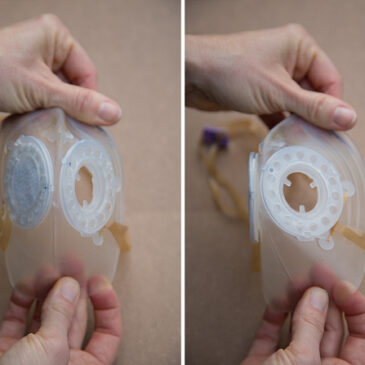
For healthy reasons please make sure that you wear a mask during the whole process.

Pastels (3)

© Marc Volquardsen, 2012

At this point you could halving the paste and add white pigment to achieve a set of  different values. Don’t fall in love with the colour you made from the left overs, because it will be very hard to reproduce.

Pastels (4)

© Marc Volquardsen, 2012

Now, you can roll the paste till you have a stick. Luckely my father build a wooden box for me in which I fill the paste and let it rest for a day. After that the pastel sticks easily get out. Let the pastel sticks rest  for another 6 days until they are completely dry.
Pastels (5)

© Marc Volquardsen, 2012

5 Comments

Arranging my palette III

15th, August 2011 - 09:51 PM

Pastellablage (2)

© Astrid Volquardsen, 2011

To store my pastels I decided to build some long boxes without any space holders. This way it is much easier to follow the color wheel. Further more some colors take more space and others less, so I can be much more flexible arranging them.

Pastellablage (1)

© Astrid Volquardsen, 2011


I wanted to keep to the scheme of the color wheel and I am glad I could manage that within my studio. I had only to add space for two more boxes.

4 Comments